
Let’s talk technical
Developing a new Sabre Stage 5 ECU upgrade for the RS and ST MK2, let’s take a look at the benefits…
- By
 Leighton

Focus RS & ST MK2 – Sabre Stage 5
The 2.5 turbo platform as used in the RS and ST MK2 continues to be enjoyed by many, and there is no sign of a slow down when it comes to tuning these engines. We should start by acknowledging that we have offered a very comprehensive Stage 4 upgrade path for the last few years including big turbo conversions up to 600bhp, and this remains the best option for most set-ups that follow the traditional hardware locations.
Of course, more recently we have seen an increase in alternative big turbo conversions, notably sidewinders and other non-traditional hardware layouts. This requires a very different approach to tuning and with the development of the Sabre Stage 5 platform we offer a very comprehensive tuning option that fully optimises these platforms with power goals up to 500-700bhp.
Let’s take a look below at the key features…
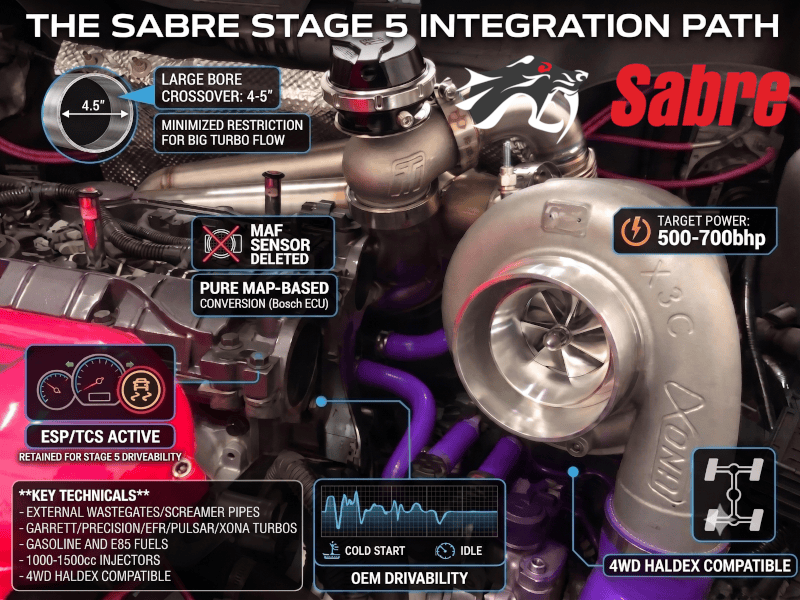
Key Technical Developments
- MAF Delete & Speed-Density Conversion: The factory Mass Air Flow (MAF) sensor is completely unpinned and deleted. The ECU’s airflow model now follows Manifold Absolute Pressure (MAP) and Intake Air Temperature (IAT) to mathematically track air mass and load calculation.
- 4″ – 5″ Large Bore Crossover Pipes: This major increase in cross-sectional area eliminates pre-compressor restriction, lowering turbocharger discharge temperatures and optimising compressor efficiency at high pressure ratios.
- Unusual Layout Flexibility (Sidewinder & External Wastegates): The architecture is fully optimised for high-clearance sidewinder manifolds that reposition the turbocharger to the side of the engine bay and incorporate very short intake tracts.
- Advanced Fuel Injection Dynamics (1000–1500cc): Engineered specifically for motorsport-grade injectors (e.g., 1000cc, 1200cc, and 1500cc configurations). Full control of large injectors for drivability, economy and emissions.
- Class-Leading Knock Control: Optimised factory Bosch individual-cylinder closed-loop knock control. Ignition timing is adapted dynamically per cylinder based on targeted acoustic frequencies, providing an essential safety net when running high boost on pump fuels or E85.
- Factory Traction Control (ESP) Enabled: Historically, unplugging the MAF sensor drops CAN-bus torque synchronisation, instantly disabling factory traction control. The Stage 5 calibration retains the factory ABS/ESP module and allows full use of the ESP button without dash lights.
- 4WD Haldex Conversion Compatibility: Developed to fully support custom 4WD Haldex conversions allowing you to switch from FWD to AWD seamlessly.
- OEM Drivability, Idle, and Cold Start: Enjoy perfect closed loop fuel control, economy and emissions. Cold start, idle and drivability retain full OEM+ features and allow the car to drive and function as you would expect.
Why unlocking the fuel system is so important for the Fiesta ST MK8 and Puma ST…
- By Leighton
FUELING THE FIRE
Why unlocking the fuel system is so important for the Fiesta ST MK8 and Puma ST
Pushing the 1.5 EcoBoost engine with a “Stage 3” hybrid turbo setup has always meant hitting a hard wall: the factory fuel system. In short, the stock hardware runs out of capacity, forcing tuners to cap target air-fuel ratios to 0.84 lambda. This is just about okay for general running, but it leaves no margin for safety or extra performance.
With the Sabre fuel upgrades, we not only increase capacity, we ensure there is redundancy for the “what if” scenarios. The fueling upgrade doesn’t blindly dump excess fuel into the engine. Instead, it unlocks the capacity to run down to 0.74 lambda across the entire rev range if required. This vital volumetric headroom restores the factory ECU’s ability to protect the engine when it matters most.
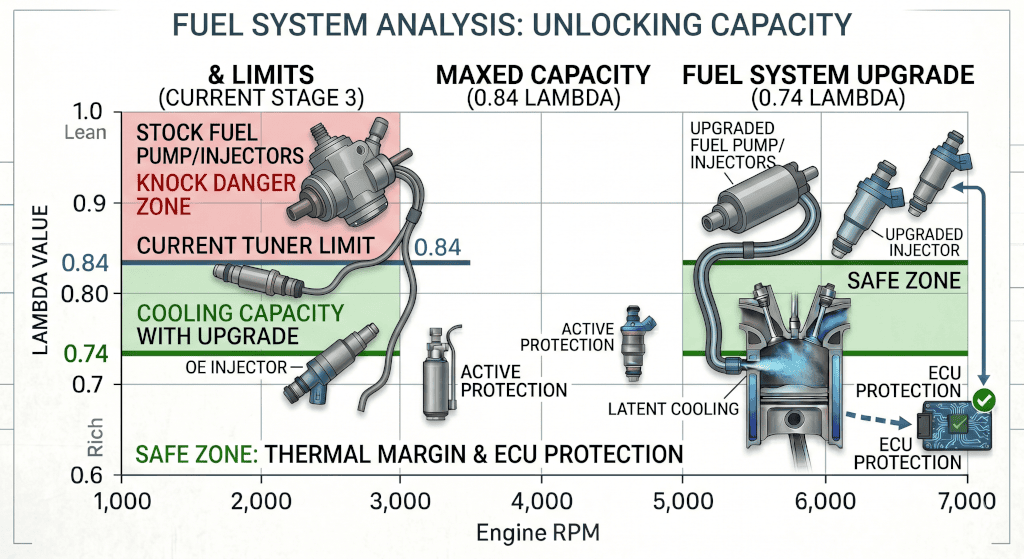
1. Restoring the ECU’s Native Safety Features
Modern EcoBoost ECUs are highly sophisticated. When they detect spark knock (detonation) or critical Exhaust Gas Temperatures (EGTs), their first line of defense is to enrich the fuel mixture to cool things down.
Without the fuel system upgrade, this safety net is paralyzed. Because the stock hardware is already maxed out maintaining 0.84 lambda, the ECU cannot add more fuel, even if its programming demands it. Unlocking the extra fuel capacity gives the ECU its weapons back, allowing it to instantly quench heat and save pistons during a bad batch of fuel or a prolonged high-speed pull.
2. In-Cylinder Cooling On Demand
At Stage 3 boost levels, hybrid turbos generate immense heat. When the fuel system has the headroom to enrich, the excess liquid fuel acts as a chemical intercooler. Through the latent heat of vaporisation, this extra fuel absorbs massive amounts of thermal energy as it turns to vapor, directly cooling the combustion chambers, valves, and cylinder heads.
3. Pushing Past the Knock Limit
When restricted to a lean mixture, high combustion temperatures make the engine highly prone to knock. This can limit tuning potential, forcing a defensive position and pulling back ignition timing (losing power) just to keep the engine safe. The added cooling capacity of fuel inherently resists detonation. This allows tuning to safely optimise spark timing for maximum power, knowing the fuel system has the volume to back up the ECU if conditions turn poor.
4. True Top-End Protection
On stock fueling, safety fades as RPMs rise. This upgrade provides consistent, high-volume flow straight to redline where it needs it the most, ensuring your engine is just as protected at 6,500 RPM as it is at 3,500 RPM.
Headroom is Safety
Upgrading your fueling hardware isn’t just about being able to achieve extra power—it’s about giving the ECU the volumetric headroom it needs to do its job safely and effectively.
| Feature | Stock Fuel System (0.84 Lambda Max) | Upgraded Fueling System (0.74 Lambda Capacity) |
| ECU Safety Features | Disabled: Cannot enrich further to save the engine. | Fully Functional: ECU can freely dump fuel to quench knock or high EGTs. |
| Thermal Protection | Fixed margin; highly vulnerable to heat soak. | Dynamic cooling via fuel vaporisation when demanded. |
| Top-End Delivery | Hard capped; safety margins diminish as RPMs rise. | Sustained volumetric flow and protection all the way to redline. |
| Engine Longevity | Higher risk of failure if ambient conditions turn poor. | Maximum safety margin and active component protection. |